Our First Gospel Preachers
The first sermon preached on Australian soil, and the two ministers who laid the foundation of the nation's Christian heritage.
Written By
Editorial Team
“What shall I render unto the LORD for all his benefits toward me? I will take the cup of salvation, and call upon the name of the LORD.”
Psalm 116:12–13
This was the first passage of Scripture preached on Australian soil, at 10am on Sunday, 3 February 1788. The very first service, ordered by Captain Arthur Phillip, was held under a great tree near Sydney Harbour. “No man was to be absent on any account whatever,” decreed the captain. After a 36-week voyage in which all eleven ships were spared miraculously by God, it was a very fitting text indeed.
From our Christian heritage viewpoint, it was critical that a man of God deliver the first message. That man was the Reverend Richard Johnson.
God worked in the preparations
The discoveries of Captain James Cook in 1770, along with England’s need to find places for its convicts, led to great interest in New Holland. During this time John Newton — the writer of Amazing Grace — and a group known as the Eclectic Society began considering how they could further the cause of the Gospel at Botany Bay.
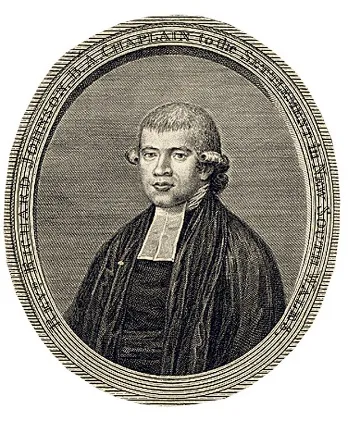
Newton wrote: “A minister who should go to Botany Bay without a call from the Lord… had better run his head against a stone wall.” Enlisting the help of the anti-slavery campaigner William Wilberforce, a member of the British Parliament, Newton’s goal was to convince Prime Minister William Pitt to appoint Richard Johnson as chaplain. As providence would have it, the man Newton approached for assistance happened to be good friends with Pitt, and their goal was achieved.
In October 1786, Johnson received a royal warrant as chaplain to the colony of New South Wales. Thanks to Newton and the generosity of the Eclectic Society, the reverend brought to Australia 2,000 Bibles and other Christian books. When you study history, you will always see the hand of God at work.
The work of Reverend Johnson
Johnson’s first flock comprised convicts (568 males, 191 females and 13 children), four companies of marines, and the governor, Captain Phillip. “It is my duty to preach to all, to pray for all, and to admonish every one,” he said. By the end of 1788 his ministry extended with the growing colony to Rosehill, near Parramatta, which he visited monthly and then fortnightly by boat.
His ministry included visiting the sick, of which there were many. In the first five years he conducted 226 baptisms, 220 marriages and 851 funerals. He organised a fund to care for orphans, especially after the Second Fleet arrived with hundreds dead and dying. Using his own hands and his own money, Johnson built a church in Macquarie Place, Sydney, beginning in 1793 and completing it despite intense opposition from the Rum Corps.
Three years after the first settlement, Johnson started Christian schooling for both convicts and free men, establishing the first schools in Sydney, Parramatta and on Norfolk Island. By 1799 his schools showed 526 children enrolled in Sydney, 239 at Parramatta and 166 at Hawkesbury. Thus early Australian education was initiated not by government legislation and funding, but by the Christian Church.
God provided an encourager
In 1794, the Lord encouraged Richard Johnson’s heart with the arrival of the Reverend Samuel Marsden, a like-minded minister of the Gospel who took up the work at Parramatta. By the time Johnson left Australia in 1800, some twelve years after his arrival, a firm foundation for Australia’s Christian heritage had been established. Marsden took over the chaplaincy of Sydney until a replacement, William Cowper — coincidentally another of Newton’s recommendations — arrived in 1809.
While in England, Marsden was given five Spanish sheep from King George III’s own flock, along with 100 acres from General Grose, and soon became known as the best practical farmer in the country. He had a vision for commerce in the wool trade and established the New South Wales Agricultural Society in 1822.
Marsden takes the Gospel to New Zealand
With the sales of his sheep and wool, Marsden purchased a ship called the Active, which he used for missionary endeavours, bringing the Gospel of Jesus Christ to New Zealand and the islands. He believed Australia was to become a “hub for evangelisation of the heathen nations surrounding her.” The crowning work of Marsden’s life was the introduction of Christianity to New Zealand; its name was on his dying lips, and it is not without cause that he has been called “the Apostle of New Zealand.”
The heart of our first preachers
“I am not ashamed of the precious Gospel of Jesus,” said the Reverend Richard Johnson. “It is my opinion that God will ere long visit New South Wales with His heavenly grace,” said the Reverend Samuel Marsden.
It is by no coincidence that our first preachers were men of God who believed the Bible. Johnson was known for his deep sense of calling, his great love of the Bible, and his life of prayer; a man of compassion and strong Christian character who showed courage in the face of incredible hardship. Marsden was a born organiser with a passion for work — courageous, conscientious and devoted to his duty. What wonderful examples were set by these brave men in those first few years of our nation’s history.